
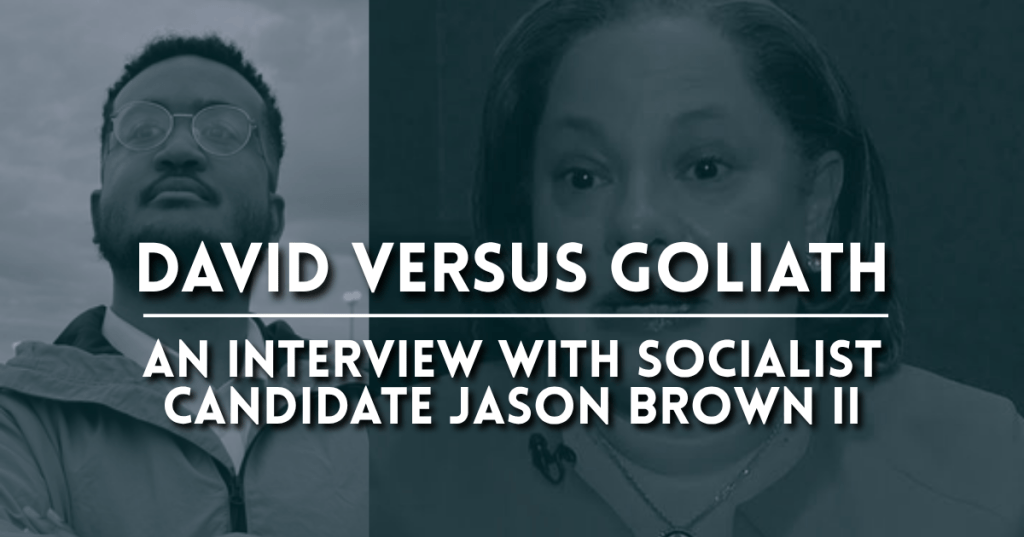
Recently we sat down with Jason Brown II, an independent socialist candidate running against Democratic incumbent Jennifer McClellan in Virginia’s 4th congressional district. Brown’s campaign unabashedly attacks McClellan’s pro-war, corporate base and believes Virginia workers deserve better representation than the monied interests represented by McClellan. Read the following interview as we cover Brown’s early background from Christian fundamentalism and evolution towards revolutionary socialism, the role of a socialist in office, the difficulties of running an insurgent campaign, and challenging liberal “common sense”.
The Virginia Worker: Could you tell us a little about your background? Why run for office?
Jason Brown II: I really just see it as my life’s calling, being able to serve my community in this capacity. I look at all of the god-given strengths, talents, and gifts that I have that all align with serving my community in public office. I first volunteered when I was 15 years old leading up to the 2016 presidential election, I volunteered for a congressional candidate and the gubernatorial election in 2017, I got a very early start, and when in high school I was running for class president, president of this club, secretary of that club, I’ve always enjoyed serving in leadership capacities. Once I became of age to officially serve my community in political roles it just seemed like a no brainer. I really do have a heart for the people. It’s extremely unfortunate that there are a lot of individuals who vie for our votes, who tell us they will do one thing, overpromise and underdeliver.
For me it’s always been about stepping up to the plate to be the leader I know my community is hungry for. When I was 22 I ran for school board and eventually got elected to that role. Unfortunately I found out about all the politics behind the scenes, I learned very quickly a lot of the things I aspired to do just weren’t going to happen. I’m a political organizer before I’m an elected official. My belief is working shoulder to shoulder with individuals in the streets is how we win, I don’t believe Im THE solution, I don’t believe people voting for me is the solution, I think it’s when they’ve entrusted me to come back out into the street to join them and to use my seat for empowering the people. I think that’s where the solution lies.
VW: Are you from the 4th district?
JB: I’ve been in Dinwiddie County since I was in kindergarten.
VW: What was it that radicalized you to identify as a socialist and run against a prominent Democrat with bona fides as a “progressive”?
JB: For me I didn’t start on the left side of the aisle when it comes to politics. I always tell people who I engage with politically that this work that we’re all doing requires supernatural humility. I dislike when I see individuals who have this air of liberal self righteousness, where they’re like “this MAGA Trump supporter Im gonna completely write them off, there’s no hope in saving them.” I completely disagree with that, because I do believe I’m fighting for all the working class, and that includes parts of the working class that have oppressed me or alienated me. At the end of the day I’m never going to be in the position to decide who to leave behind. I don’t think anyone has that right. So when I said I actually volunteered to campaign when I was 15 that was for the Trump campaign. That is not a joke, I still have pictures of me as a young Black teen with older white individuals holding Trump signs. I volunteered for republican Mike Wade running for congress. I started with very conservative politics and that had a lot to do with my upbringing. I grew up fundamentalist, I didn’t leave fundamentalism until I was 22 years old. I was actually expelled from bible college.
I’ve been through a lot that has really shaped me as an individual politically. By high school I still identified as a conservative, but there were certain issues where I delineated from that. I was very progressive when it came to the environment, when it came to women’s rights. I was a part of a group called the feminist majority and they have a program for schools called GLI – Girls Learn International. It was interesting to see me, a well known republican, be an officer. I was the community outreach coordinator for GLI. Once I went to college I started to view myself as a pro-life Democrat, this was around 2020 – the summer of George Floyd, that was what radicalized me.
After his murder I was exposed to leftist and socialist thinking through social media. I would see different posts that at first kinda shocked me. I remember seeing a white friend of mine share a post saying “the people who built this city have a right to burn it down’’, and I remember seeing people say “we want to abolish the police” and I thought that was crazy. But the more I learned, the more radical I became. I remember staying up at night when I was in college and falling asleep to Angela Davis speeches. I was really trying to take in as much information as I could. Eventually I joined the DSA, which played a role in me being expelled from bible college. And then eventually I moved further left from that and became a revolutionary socialist. As an elected official and as a political candidate my worldview is that we need revolution in order for us to win the world that we want.
VW: With your background in Christian fundamentalism would you still identify with this or has it evolved?
JB: I’m still very devout in my faith, it does inform my politics, I share aspects of my faith with people pretty often. My religious beliefs and my political beliefs are very seamlessly merged. There were theological things I was taught that I’ve had to unlearn. The Rapture was probably the biggest one. Rapture fear is something that sticks with you. Even now when I hear a train go by I think to myself “oh my god that’s the trumpet sounding!” Something that does relate to my political journey is being raised in Christian zionism, I’m a bit ashamed to say this, and speaks to a genuine change of heart, I didn’t leave Christian zionism until right around 2023 when I got involved in political organizing and participated in a national march for Palestine in DC.
I grew up hearing all the time the bible says God told Abraham whoever blesses you I’ll bless, whoever curses you I’ll curse, and being told if you speak out against Israel God will curse you. Growing up it’s not something I was able to easily walk away from. I’m explicitly pro-Palestine and proud of that, but even now sometimes I still have a little voice in my head saying “this is wrong” to speak out. But I think it’s important for leaders to be open and vulnerable about these things. I wanna show people you can change, that it’s possible to hold a particular belief, but still develop and really put people first.
VW: You said you were in the DSA. Some of the most prominent members in DSA run as Democrats. What made you want to run as an independent socialist?
JB: For me, it was about principle and practicality. The practical side of it, if I were to run as a Democrat in a primary, the people who would show up to vote are not mostly working class, but party loyalists who would vote for an incumbent. The other side to it is each candidate has to collect 1,000 signatures to get onto the ballot and with the redistricting effort the deadline dates had changed. So in order for me to get onto the ballot as an independent I have until August 4th, but as a Democrat I would have had until May 26th to get on the ballot. So that was less time, especially since I launched the campaign at the end of January. I turned 25 last November and just met the age requirements. Also as part of the Democrat primary process you have to pay $3,480 dollars as a “primary filing fee”.
As an independent I had a later deadline for signatures and I didn’t have to pay a primary filing fee. I was also able to run with the principles I believed in. I knew it would be difficult to talk to people and advocate for what I believe if I ran in the two-party system. I believe that the working class has outlived any usefulness of either party. It’s time for people to step outside of that duopoly. I’ve talked to so many people regardless of political affiliation who agree the two parties don’t work for us. It’s time leaders step up and show it’s possible to run outside the two-party system and to win the world we want. I also didn’t want to have strings attached. I didn’t want to have a filter where I need to be explicit and have a sharp tooth when it comes to issues impacting the community. If I ran as a Democrat there would be so many things where the party says “you can’t go that far left”.
VW: The rhetoric of the Democrats is one of “protecting democracy” but the reality is any time independent socialists try to run for office Democrats will try to prevent other candidates from running against them, whether through financial barriers or regulatory barriers.
JB: You speak to the financial barriers, that’s something very important for grassroots candidates to consider. I started with zero dollars and zero volunteers, no party infrastructure and a lot of this was self funded. Unlike when I ran for school board, seeking federal office places a $2,000 dollar cap on what I can spend out of pocket and I’m very close to that, which means I’m going to reach a point where my campaign is purely run off volunteer donations, because I won’t be able to swipe my credit card to pay for things. Now compare that to Jennifer McClellan, who has a whole party infrastructure behind her. I look at the amount of money we’ve both raised and she has over a million dollars. It’s not because people are enthusiastic and excited about her, it’s because there is an infrastructure that exists, which includes a legal team, ties to industries and other powerful connections a grassroots candidate doesn’t have.
I will say, when McClellan voted “no” on the Massey amendment to cut funding to Israel we had a surge of interest in volunteers and donations for my campaign. Only one of us runs on a platform to support Palestinians, to abolish ICE, among other issues. So many people when they see my logo calling to abolish ICE will sign my petition, and commit to voting for me without seeing my stance on any other issue. It proves to us we have a winning message. Our biggest hurdle right now is to have enough people to get that message out. Every precinct we go to people are loving what we have to say.
VW: What would you say to people who think McClellan is “progressive”? She says she supports affordable healthcare and housing, is against Trump, etc. Have you experienced any rhetoric from her campaign or supporters that you’re disrupting the ability to “stop fascism”?
JB: It has happened, but it’s very rare that I run into someone who says they’re very committed to McClellen. I would say most of her “supporters” are people who vote Democrat to oppose Republicans. I did that with Joe Biden! I didn’t really believe in it, but I wanted to keep Trump out. I’ve been asked “where has McClellan voted wrong?” and what I tell people is that this is much bigger than her and me. I refuse to use language “I’m running against her” as if it’s her seat. We are both running for the same seat, but with different visions.
There’s a difference between saying you are for affordable healthcare vs healthcare is a human right. There’s a difference between saying you are for affordable housing vs housing is a human right. My plan is to cap rent at 10% of household income. There’s a difference between saying ICE agents shouldn’t wear masks vs recognizing ICE is bastardized, we can live in a world without them. There’s a difference between her saying she wants peace in the Middle East and I’m the only candidate calling for the liberation of Palestine, and not only that but reparations being paid to Gaza.
There are many ways where she has a “decent” track record, but decency doesn’t lower rent. I’m a renter, I’m a college student. Decency hasn’t made college more affordable for me. Decency hasn’t caused insurance costs to go down. She hasn’t met the moment, we need leaders who are going to meet the moment. I am Gen Z, I was born in 2000, I know my generation is inheriting all the crises, whether it’s the housing crisis, the climate crisis, data centers and AI. We really do need people who are impacted by the issues to be able to resolve the issues.
VW: We’re sure in some peoples’ minds they would question even running against McClellan. She’s caucused with the Squad, AOC, and DSA electeds who say they’re socialists. To circle back to something you said before regarding the difficulty of running a grassroots campaign without the infrastructure Democrats have, does this not speak to the need for Virginia workers to have their own party? To be able to challenge the two corporate parties?
JB: Yea, I certainly agree with that. It’s very difficult for insurgent candidates to find their footing when challenging incumbent candidates. Not only from an electoral side of things, but also from a revolutionary socialist position there has to be a party to restructure and reconstruct society. It has to be revolutionary, that party shouldn’t be fixed on electoralism, we should participate in electoral politics and meet where workers are at, but not centered on that. We would run the risk of being like the Green Party where they were so fixated on winning 5% of the vote to legitimize themselves under the bourgeois system. What are you gonna do after that? You get 5% and unlock some public funding, but you’re not going to be able to change things simply through electoral politics.
VW: We appreciate that distinction, it’s not enough to just win office under a capitalist system, but to organize the working class to achieve state power. They’re not the same thing. Do you see a utility in running independent socialist candidates against Democrats or Republicans even if they are heavily favored? And to build off that, say you win office, what is the role of a revolutionary socialist while in office?
JB: I would say my role is to go back out in the streets with the people who elected me and continue to work with people there. I have to stay out in the streets in order to win anything. I ran into that issue here in Dinwiddie County when I was elected to the school board. The number one issue I campaigned on was bullying. I remember so many people made the decision to vote for me because of that and after I was elected I couldn’t find those people again to organize with them. It became an issue of everything depended on me to get things done and I am a singular vote against four other votes, nothing I put forward would get passed. That’s where organizing comes into play.
There was just no foundation laid to organize here in the county. You see McClellan show up to give a speech as a pro-choice rally, but where is she beyond that? She’s not out on the streets with the people fighting against literal genocide. That’s where I sharpened my teeth, where I got my start. I think there’s a lot of benefit to running individuals who are outside of the two-party system who are revolutionary socialists. In education there’s what they call the “zone of proximal development” where there’s recognizing where people are, but then where we intervene and expand consciousness to show what’s possible.
VW: Do you have any ties to organized labor? We assume there’s a Dinwiddie Education Association, have you sought endorsement? What’s been the response from union members?
JB: There’s a local, but it’s a skeleton now. That was a part of my platform when running for the school board – to revitalize the teachers union. I work for Richmond Public Schools fulltime right now and I am a member of the Richmond Education Association. I had reached out to SEIU Local 512 and spoke with their executive director. He was upfront and said they’ve already voted to endorse McClellan. I still want to meet with their members and fight for the class. With the REA they don’t have a political action committee yet so can’t offer an endorsement.
However I have applied for an endorsement from the VEA. It’s interesting, the VEA’s candidate questionnaire asks a lot of questions about education, but then asks a question like “do you support a ban on assault weapons?” I don’t! I believe the capitalist class isn’t going to ban themselves from having them, they’re going to use them against us. We need to prioritize the right to bear arms, particularly for minorities because there is a threat.
VW: How can workers support your campaign?
JB: What would be extremely helpful is donations. McClellan already has a million dollars for her campaign. I’m reaching my personal spending cap. Social media engagement is extremely helpful. Resharing graphics, etc. Visit jasonforcongress2026.com


Leave a Reply