
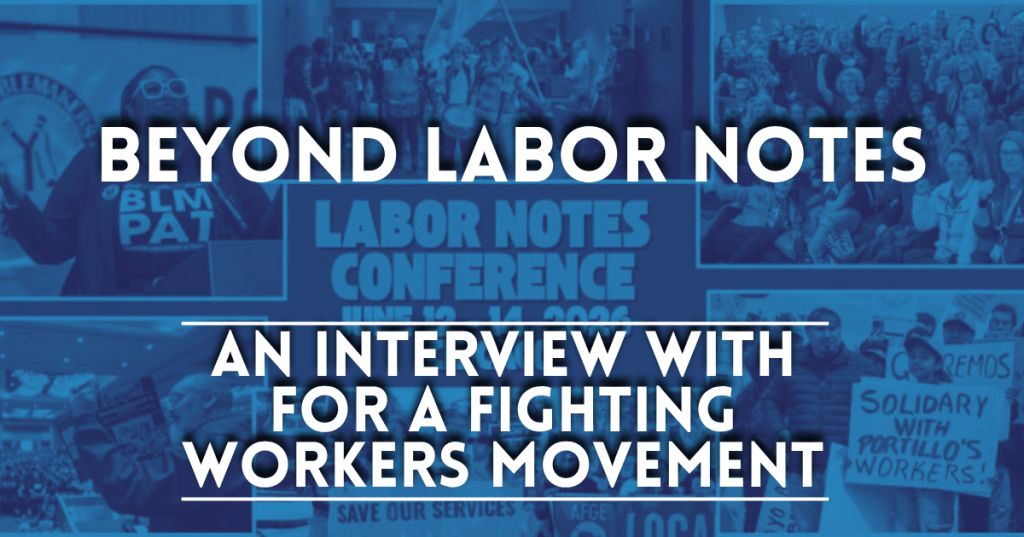
The following interview is with a representative of the Class Struggle Action Network, which is a participating organization within the For A Fighting Workers Movement. For a Fighting Workers Movement will be hosting their event concurrently with the 2026 Labor Notes Conference with the goal of bringing together worker militants who wish to break free from the dominance of labor reformism.
VW: Could you provide some background on how this effort came about? What groups were initially involved and what drove them to start this?
CSAN: The effort emerged out of discussions between militants and workers active in different unions, workplace committees, immigrant defense efforts, and class-struggle circles who increasingly found themselves running into the same limits inside the existing labor movement. In different sectors workers were confronting the same problems: isolation of struggles workplace by
workplace, the containment of strikes within legal channels, the deadening effect of grievance procedures and arbitration, and the constant effort by the union apparatus and labor-left reformists to subordinate class struggle to electoral politics and collaboration with management.
Out of this came attempts at coordination between different workplace militants and organizations. Within that process, militants active in Class Struggle Action Network (CSAN) participated in helping initiate what became For A Fighting Workers Movement. The organizations and committees involved are not identical politically, and there is no single ideological line shared across all participating groups beyond the basic points of unity publicly adopted.
That distinction is important. Speaking for myself as a militant of the International Communist Party (ICP) and the elected lead organizer of the CSAN, there are broader political conclusions that emerge from our communist analysis which are not necessarily the consensus of the coordination as a whole. The coordination is a practical effort around class struggle orientation, militant organizing, rank-and-file initiative, generalized strike perspective, opposition to class collaboration, and international working-class solidarity. It is not a unified political party or doctrinal bloc.
What drove the effort was the recognition that many workers are searching for something beyond the endless cycle of reform caucuses, contract campaigns, symbolic protest politics, and ineffective strikes. There is a growing layer of militants trying to rediscover methods of real collective struggle.
VW: We see your initial event is being held at the same time as the annual Labor Notes convention in Chicago. Is this meant to attract the leftwing of Labor Notes attendees or attract a different crowd?
CSAN: The answer is both and more, though perhaps not in the way people normally think about it. Many workers attending Labor Notes are genuinely militant workers looking for ways to fight back. A large number are frustrated with the official union leadership and are searching for methods capable of overcoming stagnation and defeat. We are not indifferent to those workers.
They are part of our class.
At the same time, we believe Labor Notes as an organization represents the left wing of class collaboration within the labor movement. Its role historically has been to renew confidence in the regime or business unions through reformist politics, meaning union democracy, reform caucuses, leadership replacement, legalistic strategy, and closer integration with progressive
wings of bourgeois politics.
Our critique is therefore not aimed primarily at the rank-and-file worker attending Labor Notes looking for answers. It is aimed at the political limitations of labor-left reformism itself and the misleadership that directs it.
We should note that the reformist wing in the labor movement is generally opposed to our ideas, usually in the name of practicality. For example, Teamsters for a Democratic Union is hostile towards Teamsters Mobilize and bans them from their events while discrediting their ideas. Just recently, a member of TM was banned from entering the whole Labor Notes conference.
CSAN members in UFCW, the NEA and SBWU have faced marginalization and irresolvable political and tactical disputes from those aligned with the labor-left. Still, we seek to reach workers within the conference itself and will be intervening inside where it makes sense to do so.
Labor Notes may platform ideas such as breaking the no-strike clause, independence from the Democratic Party or even anti-capitalism, but the goal of Labor Notes and its reform caucus affiliates isn’t to make good on these things, but to funnel this militancy into opportunism. It does this by overstating immediate gains such as lobbying/electoral victories, contract signing, and protest efficacy. These short term wins (and sometimes they are paltry wins that demoralize workers) eventually fade away as the necessity of capital accumulation and its complement of increasing exploitation takes priority. Workers are then left subordinated to contract law and politicians while being told to stay realistic and defend capitalist democracy.
Ultimately, they seek to keep workers within the confines imposed on them.
Holding the event alongside Labor Notes allows a direct line of demarcation to emerge between two perspectives: one seeking to reform the existing labor regime, and another seeking to rebuild organs of class struggle capable of acting independently of the state, the employers, and the logic of labor-management collaboration.
Our event will access an audience outside of the city as it will also be online and in-person with a viewing event in Portland, Oregon which will give the opportunity for engagement with workers who won’t be attending the labor notes conference.
VW: What do you hope to achieve from this first event? Will this mark the beginning of a new formation to contend with Labor Notes?
CSAN: The immediate goal is clarification and coordination.
There are militants scattered across unions and workplaces who already instinctively understand many of these problems, but who remain isolated from one another. Bringing those militants together matters. Clarifying political differences matters. Developing relationships between workplace committees and struggles matters.
The effort is not conceived as a rival Labor Notes conference, nor as an attempt to build a new permanent labor federation by proclamation. Historically, genuine workers’ organs emerge out of periods of intensified struggle, not through administrative declarations. What can be done now is laying groundwork: helping connect class-struggle militants across industries and regions, encouraging forms of organization capable of generalized struggle, and developing a pole clearly opposed to both the official bureaucracy and labor-left reformism.
CSAN knows from experience that we need to grow through collective planned activation not just through conversations and debate to create absolute theoretical unity. This event was the first task of these militant formations to struggle through together. If the effort is to continue, the
next concrete action will need to be organized as to allow us to concentrate our efforts on what we struggle towards as a shared aim. This ought to result in us moving towards concrete ways of sharpening workers’ strength in the struggle, rather than reconciling every single one of our differences in theory and tactics into some sort of consensus as our main objective. All of this
depends on the course of class struggle itself.
VW: What do you see as the primary tasks in building a fighting workers
movement? What are the main obstacles?
CSAN: The primary task is rebuilding class independence. That means overcoming the fragmentation imposed on workers by bargaining units, industries, nationality, immigration status, race, craft divisions, and legal jurisdictions. The capitalist class benefits enormously from maintaining layers of workers with different wages, statuses, and legal protections.
CSAN’s position is that it also means abandoning electoral politics entirely, meaning no money or endorsements to all political candidates who constantly go back on their promises and are allied with capitalism. The only way to secure gains is not by having friends upstairs, but by having the militancy from below to maintain them and keep fighting for more.
One example is the treatment of immigrant workers subjected to ICE raids and super-exploitation. A class-struggle movement cannot simply respond morally or symbolically. It must fight materially if it is to have any real ability to coerce the state. The answer is not “support immigrants” as an abstract slogan, but unified economic demands that eliminate the ability of capital to super-exploit sections of the class, i.e. removing the very basis of that which divides us.
That means fighting for equal wages across nationality lines, abolition of tier systems, equal benefits, opposition to subcontracting, and generalized strike action capable of stopping deportation terror through direct working-class force rather than toothless appeals to courts or politicians.
If immigrant labor can be terrorized into accepting lower wages and worse conditions, then the conditions of the entire class are dragged downward. The only real answer is unified class struggle across borders and legal statuses.
Of course, this is not realizable in the immediate future, but that doesn’t mean we should water down the strategy and pursue only what’s possible in the now. We need to build along the pathway towards achieving this kind of defense because it is the only effective way forward.
The obstacles are enormous. The state, labor law, the union bureaucracy, nationalism, racial divisions, legalism, electoral illusions, and simple exhaustion after decades of defeats all weigh heavily on workers. The labor movement has been trained for generations to think in terms of contracts and procedures rather than class power.
VW: We see in the points of unity the call for unions to break from the
capitalist parties, does this mean the advocacy of an independent working class party?
CSAN: In short yes, but there is not complete political agreement across all participating groups on the exact details of the answer to that question, specifically as it regards whether or not that independent working class party itself participates or not in the electoral system of the capitalist state itself which asks workers to vote in leaders to manage capitalism for that nation state.
Speaking from the standpoint of the ICP and militants within CSAN, the political independence of the working class from all bourgeois parties is absolutely necessary. The Democratic and Republican parties are both parties of capitalism and imperialism, which every group in the coordinated effort agrees on.
At the same time, we distinguish between the economic organizations of the class and the revolutionary political party. Trade unions or workers’ defensive organizations cannot substitute for the communist party, nor should they be transformed into fronts for one political tendency. The united front on the economic terrain must include workers with many different levels of political consciousness so long as they are prepared to struggle materially against capital.
There is broad agreement that the working class requires organization beyond isolated workplace struggles, but there are differing conceptions within the coordination regarding political form.
From the ICP standpoint, the revolutionary party is indispensable and comes from outside the battles of class struggle because the working class does not spontaneously maintain historical continuity of revolutionary program through periods of defeat and counterrevolution. The party preserves lessons, programmatic clarity, and revolutionary orientation across generations.
But the party is not a substitute for workers’ self-organization on the economic terrain. Nor can economic struggle alone spontaneously produce revolutionary politics. There is therefore a necessary relationship between class struggle organs and revolutionary political organization, while still maintaining distinction between them.
VW: Historically among the leftwing of the labor movement there have been two approaches for labor organizing: “boring from within” as some leftists proposed to transform established unions, or “dual unionism” among other leftists who saw established unions as too corrupt to reform, pushing for organizing new competing unions. Is there consensus on this question? If so, what?
CSAN: No, there is not total consensus. From the ICP standpoint, both formulas become mistaken when turned into rigid principles. Communists do not abandon the masses wherever they are organized, including within the existing unions. That means intervention within established unions remains necessary wherever workers are present and struggle is possible.
At the same time, we reject the illusion that the regime unions can simply be transformed back into class organs through democratization or leadership replacement. Likewise, proclaiming entirely new unions in isolation from real mass struggle generally produces artificial organizations disconnected from the broader class.
Historically, genuine organs of class struggle emerge unevenly and concretely: strike committees, assemblies, rank-and-file committees, inter-workplace coordinations, territorial committees, and sometimes new union forms arising through struggle itself.
For example, in Italy, workers spontaneously formed grassroots rank-and-file unions in a “dual union” like structure because it was practically demonstrated to them the outright betrayal and unreformability of the state-controlled unions. So, a significant portion of workers abandoned the mainstream unions of their own accord. It is worth noting, though, that these grassroots unions are not explicitly leftist or revolutionary, but are simply able to actually perform the defensive tasks as desired by the workers. The problem of opportunism still plagues these unions as well. It is possible, for a similar situation to erupt in the mainstream unions in the US.
The question is not choosing an abstract formula in advance, but developing real organs of struggle wherever conditions permit.
VW: Breaking from the norm of arbitration, mediation, and proceduralism within the established unions is a monumental task. Not only would it require a cultural shift in the unions, but also would require developing the ability for unions to weather state repression via injunctions, mass arrests, and criminalization of unions if they become more militant and less concerned with legality. How do you win workers and unions over to this orientation?
CSAN: Primarily through experience. Workers generally do not abandon legalism because they read an argument against it. They abandon it when legalism fails them repeatedly in practice. The contradiction is already sharpening. Workers are told strikes are illegal, solidarity actions are illegal, secondary boycotts are illegal, wildcat actions are illegal, and increasingly even militant contract fights are treated as unacceptable disruptions to national stability.
Eventually workers begin recognizing that the legal framework itself exists to contain class struggle. This process of course is helped by the developing economic crisis and increasing exploitation faced by workers. The task of militants is not to lecture workers abstractly about illegality, but to help organize practical forms of solidarity and collective action that demonstrate workers’ actual power. Even limited experiences with collective direct action can radically alter workers’ understanding of what is possible. Historically, every serious labor movement has had to confront state repression. There is no purely legal road to class struggle.
VW: It seems that the labor bureaucracy is recognized as a hindrance to the development of a fighting workers movement. What role do you see the labor bureaucracy having within established unions? Are they purely a reactionary bloc, or can the bureaucracy be transformed?
CSAN: The bureaucracy is not merely a collection of bad individuals. It is a social layer tied materially and institutionally to the management of labor peace. It does not hold its own distinct interest, but rather is an expression of the bosses and their interests as members of the labor aristocracy.
That does not mean every union official is identical politically or personally. Contradictions exist. Some officials may support militant actions under pressure from below or during periods of intensified struggle. But structurally the bureaucracy exists to mediate between labor and capital within the
framework of capitalist legality. That is why even reform currents tend to become administrators of the same apparatus once in office. This is one reason why reform caucuses repeatedly reproduce the same dynamics they
originally opposed.
VW: Does this united front see the need to run for leadership roles within the existing unions? What are the primary mechanisms to change the current reformist and economistic norms within the established unions?
CSAN: There is no single line across the coordination on electoral participation inside unions. Some groups participate in elections tactically. Some endorse voting for alternative leadership. Others are more skeptical.
From the ICP standpoint, such participation can only ever be subordinate and tactical, never strategic. The central issue is not capturing apparatus positions but rebuilding workers’ capacity for independent collective struggle. If a leadership position within a union advances this, then it is useful. But it is not the benchmark of success for a growing workers movement if it is simply
swapping leaders out in a system made to quell workers’ struggle. More important is the movement and aims of workers to reclaim their struggle and fighting capacity.
The mechanisms that actually shift consciousness are struggles themselves: strikes spreading across workplaces, solidarity actions, direct confrontations with employers and the state, fights against tier systems, fights for unified class demands, and forms of organization that bring workers into collective action beyond the limits imposed by the union apparatus. Economism is overcome not by ignoring economic struggle, but by generalizing it and connecting struggles across sectors and divisions of the class to climb to the political level.
The most important thing today is probably clarity. The working class is entering a period of sharpening contradictions: economic crisis, housing
instability, attacks on immigrant workers, imperialist war, political polarization, and declining perceived legitimacy of institutions. Under these conditions many workers will search for militant answers. But militancy alone is not enough. The ruling class has many mechanisms for capturing and redirecting proletarian anger back into safe channels: nationalism, democratic popular fronts, electoralism, reformism, and labor-left managerial politics. A fighting workers movement must therefore root itself in class independence, generalized struggle, and internationalism.
The central question is whether workers will struggle as a class against capital itself, or whether their struggles will once again be absorbed into the “other side” management of capitalism and imperialist politics.


Leave a comment