

The following report comes from Sal Rojo as they attended the one-day conference of the Virginia chapter of the Labor and Employment Relations Association hosted in Alexandria, Virginia on September 19th, 2025.
(Alexandria) – The fourth annual conference of the Virginia chapter of the Labor Employment Relations Association (LERA) came to a close on September 19th. There were representatives from unionbusting law firms, law firms representing the AFL-CIO union leadership, those representing “neutral arbitration” firms, and minor state officials. This conference highlights that, while as individuals, these figures notionally represent different factions, they coalesce into a single professional-managerial bureaucracy, within a single “labor relations” cottage industry. This conference functions by and large as their professional soiree.
LERA was originally founded as the Industrial Relations Research Association back in 1947. Its founders believed in peaceful coexistence between bosses and workers, minimizing workplace disruption, and that class struggle is rather a series of muted legal disputes between both parties in need of mediation by government, or private arbiters (“neutrals”). This is also the framework of the National Labor Relations Act, which many of the LERA founders helped develop. The conference and its participants maintained this perspective.
LERA, however, is new to Virginia, only having formed in 2021. This coincided with the partial repeal of laws that banned collective bargaining for public sector workers, and an ensuing drive to unionize public sector workers, mainly those in Northern Virginia. In fact, all Virginia LERA conferences have had this focus on the public sector, minus a brief reference to the Amazon and Starbucks union campaigns that flared up in 2022.
Opening
Acting Virginia LERA president Arthur Pearlstein set the tone with an opening session called “What has changed in labor law in 2025?”. Pearlstein was sacked from the Federal Mediation and Conciliation Service. The FMCS is the government agency that mediates collective bargaining between bosses and unions. The Trump II administration has targeted it with an unprecedented wave of mass layoffs and buyouts. Pearlstein’s remarks echoed a common theme of the conference, stating “we are at a crossroads in the world of labor-employment relations.”
The assistant attorney for Arlington County – Adam Kurtz – moderated the first plenary session. Kurtz was a member of the Pomerantz LLP legal team, most noteworthy for their litigation in the Operation Car Wash scandal in Brazil that saw the downfall of Luiz Inácio Lula da Silva and the Workers Party. The first panelist – Stephen Kopstein – is an associate at Hunton Andrews Kurth LLP and represented Amazon for unionbusting at a warehouse in Joliet, Illinois. The second panelist – Yona Rozen – is associate general counsel for the AFL-CIO. The third panelist Isabella Hindley is an associate at Ulman Public Policy. She previously worked for the American Action Forum – which has been called one of the largest dark money groups in existence – advocated against the PRO Act, arguing against wage increases, and other policies that would benefit workers at the expense of bosses.
The first question from Kurtz was “what are the three top issues of the past year?” Rozen answered that the Biden administration was the most “pro-union” administration in her experience and that the Trump II administration has been the worst, witnessing things she’s never seen before. Kopstein answered that the constitutionality of the National Labor Relations Act is now being challenged, potentially upending US labor law that’s been in effect for 90 years and that concurrently some states are passing legislation to act as their own “NLRB” in order to fill the void. Hindley responded that some Republicans are now taking a more “pro labor” position, such as senators Josh Hawely, Roger Marshall, and vice president J.D. Vance. Rosen interjected that she disagreed with this assessment of Republicans as pro-labor and that they are rather just opportunists, and that the current Secretary of Labor – Lori Chavez-DeRemer – only came out in favor of the PRO Act when it was clear it wouldn’t be passed. Hindley responded that she sees these Republicans acting in the interest of larger political aspirations – such as presidential runs.
Kurtz asked Rozen to summarize the PRO Act. She emphasized that there’s been no major labor law passed since the passage of the NLRA, and that while public perception is at an all time high towards unions, union density is continually shrinking in part because of how difficult it is to unionize in the private sector, let alone winning a first contract. Kopstein dug deeper into the current composition of the General Counsel of the NLRB, highlighting there’s currently only one sitting member, when there’s normally three – which is needed to establish quorum for the board to make decisions. Despite the potential overthrow of the NLRA, Kopstein felt that the NLRB is still functioning more or less the same from the last administration to the current one, this includes the Biden-era rulings that found captive audience meetings to be illegal.
Rozen interjected again to contend with Kopstein’s characterization of the NLRB currently. She found that instead of replacing board members with appointees who reflect Trump’s politics, the administration is rather firing personnel and leaving the boards with vacancies and thus no quorum, this includes the NLRB, EEOC, and FLRA. The agencies are essentially being gutted. Despite this, she said, these executive orders have been challenged legally through several lawsuits from unions. These challenges have been successful at the district court level, but as the cases go into the higher courts they favor the administration. She speculated that while this has largely targeted federal workers this eventually will trickle down to state and municipal workers as well. Despite this, Rozen said she’s seen a surge in private sector labor organizing, especially among young workers nationwide.
Kurtz directed his last question towards Hindley on lobbying efforts related to labor to which she mainly replied that Trump II’s ambition is deregulation and her efforts have been to get into the administration’s ear to propose certain deregulations. Kurtz opened the floor for comments and questions with the first commenter asking in regards to the PRO Act – which would enforce faster contract negotiations – how realistic it is to force CBA’s in 60 to 90 days? Rozen replied that from her memory the language of the PRO Act wouldn’t force a CBA in such a short period, but would force negotiations into mediation. A member of the VEA spoke up to reference the NLRB with the hope of establishing a state equivalent of the NLRB, wondering how could Virginia shield itself from the chaos of the NLRB with its own state-level equivalent. Rozen replied she was unsure, but that there are other states that have been successful with their own state labor boards. Kopstein elaborated that a state labor board wouldn’t have jurisdiction over private sector workers, but only the public sector.
Best Practices for Labor Negotiations in Virginia Public Sector Session
The next session was moderated by Amy Smith who’s a partner at the unionbusting firm IslerDare. Smith asked panelists what were examples of successful negotiations, Megan Roberts – deputy attorney for Alexandria – responded with the comment of “one that we can fund” and something that is sustainable. Sarah Espinosa – an arbitrator/mediator – said negotiations where both sides come with reasonable positions, that management is looking for efficiency and fiscal responsibility, whereas the union side is moreso focused on respect. Union members look to feel heard, understood, and that management cares about them and their concerns.
Smith asked what’s the first step they take for negotiations, Roberts replied reaching out to their constituents while Espinosa said having broad representation among a bargaining unit vs a few people with pet issues. Roberts further responded on the need to retrain management after a first collective bargaining agreement is reached since prior labor relations are no longer in effect. Espinosa recognized that there’s a struggle for control between the union and management over the workplace. That there’s always a tension over this. Roberts said her social work degree has been of more use when negotiating than her law degree. She instructs management to listen to the union when negotiating. Espinosa said in her first experience negotiating, she felt she had to be aggressive, but ultimately felt it was counterproductive versus forming a working relationship between management and the union.
A participant asked what do you do when things have gotten heated. Espinoza said it’s good to switch out who’s talking. Another participant asked how do you deal with conflict in your own negotiating team. Espinosa said the members have to talk through it, and that ultimately it gets to a place where someone backs down, it’s an exhausting process. A participant from management-side said that sometimes the union side is unclear on what do they mean by certain demands, while on management-side he would work to make sure there’s a shared understanding and unity among their negotiating team. Another participant summed up some positions of the panelists, saying “don’t pound the table, work for a respectful dialogue” and asked what would management-side recommend for union members when coming to the table, to which they replied “know your stuff”. Another participant joined in to say sometimes they’ve had to govern to the outliers and focused on one bad actor versus the rest of the union members at the negotiating table.
Espinoza commented, for successful bargaining, members must be educated on what collective bargaining means and looks like, what’s in the realm of the possible. One participant asked if the panelists had experiences with different types of bargaining to which Espinoza talked about a situation where no trust was had between teachers and management with teachers having skepticism about the negotiating process even with added consultants from Harvard. Interest-based bargaining was also mentioned. Another participant asked the panelists how would they respond to Virginia municipal governments outside Northern Virginia who believe the best practice in regards to public sector unions is to have no CBA and to not recognize the unions. Smith responded by saying it was a loaded question. Espinoza responded by saying it’s been different in Northern Virginia because the municipalities were willing to recognize public sector unions and negotiate for a first CBA, but that if a municipal government doesn’t want that then it just won’t happen. Roberts responded if you can set aside fiscal issues, that bargaining can help establish clearer policies which are better for all parties.
Another participant piggybacked off the prior question asking has Virginia reached the saturation point with the current set of Virginia public sector labor laws? Panelists said yes. Smith said there are drastic differences in ordinances between counties forming a patchwork system. Another participant spoke up to say if a municipal government isn’t going to authorize collective bargaining then the organizing work of the union isn’t done. Another panelist responded that they’ve noted a difference in the level of organization between unions- such as police and firefighters being better organized than other sectors. Espinosa responded that the composition of a union shapes what is negotiated, such as a craft union versus an industrial union representing all workers in a given workplace.
How Will The Arbitrators Decide?
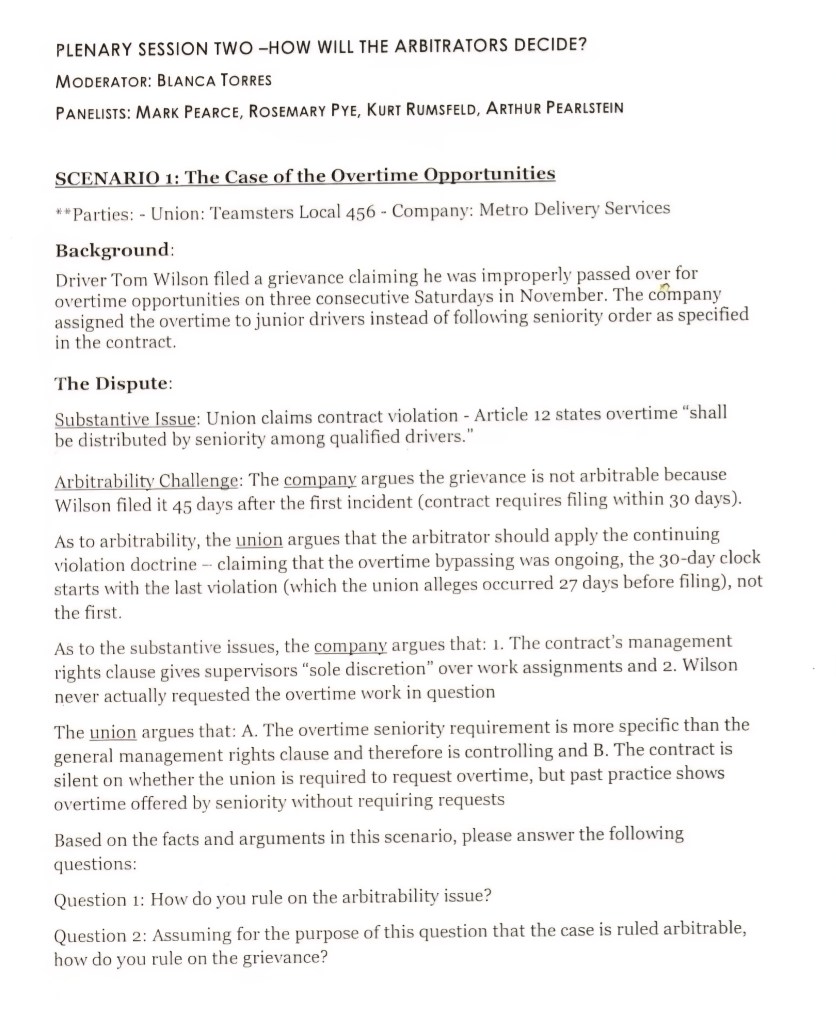
This second plenary session was interactive. Four real-life scenarios of labor disputes were given and each participant and panelist was to vote yes or no on if there was merit to each scenario and how they would rule if merit was established. The panelists consisted of the moderator Blanca Torres – an arbitrator, mediator, and administrative judge, Arthur Pearlstein – Virginia LERA president, Kurt Rumsfeld – arbitrator and mediator, Mark Pearce – former chair of the NLRB, and Rosemary Pye – arbitrator and mediator. See the following below for each scenario:


Local Impacts of Federal Changes
This panel was moderated by Cheryl Teare – mediator and arbitrator. Panelists included Michael Piccinelli – associate counsel for the American Federation of Teachers, John Sherwood – senior county attorney at Loudoun County Attorney’s Office, and Wendy Ginsberg – legislative director of Alexandria. Piccinelli spoke up first about the unilateral termination of grants with 36 pending lawsuits against the Trump II administration dealing with the Department of Justice, the National Science Foundation, FEMA, with the most recent being Fairfax County School Board for being placed on hybrid status because of policy issues related to transgender status. With the passage of the “Big Beautiful Bill” $186 billion has been cut from SNAP, medicaid cuts by $1 trillion, US Transportation funding is cut, as well as EPA funding cuts.
Teare asked Ginsberg what she’s seeing on the local level. Ginsberg said they have 16,000 residents that are federal contractors – which influences their spending habits. People are struggling to buy groceries. With federal workforce reductions businesses are needing less office space. Sherwood interjected that Loudoun County has become the data center of the world and that’s shaped the difference in their county versus Alexandria. Sherwood elaborated the difference between prior administrations in regards to prior funding while Trump II is seeking to recoup that retroactive funding.
Teare asked if there are any benefits to this situation, Sherwood said this is a very cautionary tale, that it’s a civics lesson on what to not do. Ginsberg said it reflects on IT modernization of the medicaid/medicare system and wished there weren’t such draconian policies in place. Pincinelli said it’s a disaster, stripping federal workers of their rights, and this moment is as significant as the PATCO strike under Reagan.
Teare observed that when she goes grocery shopping people are shopping in a more frugal way, looking for cheaper costs, with mom and pop shops closing down in the area as well. Teare asked what advice these panelists could give to locals, to which Sherwood said “it’s pretty hard, the reality we see right now is that funding is drying up and people need to become more savvy about charities”. Ginsberg seconded that, that locals need to turn towards their community to help with these shortfalls as well as look at new employment opportunities for folks to integrate into the AI industry. Pincinelli was the first panelist of the conference to advocate for workers to organize in response to this crisis.
Teare opened up questions from participants towards the panelists, one participant asked if there has been a mass exodus since Trump II came into office. Ginsberg responded that Alexandria is trying to invest into “affordable housing” and what policies can be put into place to benefit folks struggling to afford rent and stay in the area. She also said it really depends on what happens at the state legislature in passing policy for Virginia residents. Another participant responded they’ve seen an uptick in employee disgruntlement with all things unfolding and asking if the panelists have noticed this. Sherwood responded that they haven’t seen too much disgruntlement yet, but he thought one thing he’s seen is an uptick in EEOC charges.
Piccinelli further elaborated on the recent Charlie Kirk murder with teachers being retaliated against for expressing their first amendment rights related to criticizing Kirk. He further highlighted that as public sector workers, they have protected speech outside of their job and that it’s concerning that others are targeting teachers for expressing their free speech outside of work as others try to tie it to their jobs. One participant asked about the pushback against DEI and its relation to municipal governments. Sherwood responded this was the basis for federal intervention in local government to cut funding for not complying with their anti-DEI initiatives. Sherwood also elaborated this is how the federal government is targeting Head Start programs and Title One programs (focused on low income student bodies).
One participant asked “how do we wake up the private sector workers?,” Teare responded by saying to plug locals into a group called “Free DC”. Another participant pushed back against the idea that private sector workers aren’t awake but rather that labor law is weak and ineffective. So it’s not that workers aren’t aware, but intimidated and threatened by employers to prevent them from organizing and unionizing. Teare responded this wasn’t meant to be a “downer session” in response to these comments.
Another participant spoke up about how the VEA used to be an “employee association” versus a union until collective bargaining rights were extended to municipal workers. That it’s important to not “third party” the union versus members need to see themselves as the union in action. Another participant spoke up to complain that workers in their union only care about wage increases versus other issues. One participant asked why workers voted for Trump which they saw as voting “against their interests”, Pincinelli pushed back and said organized labor votes for “pro worker” (democrat) candidates generally, elaborating that private sector unions are shrinking, which has been the case for all our lives. Political education can be a useful tool to maybe help with this issue, he thought. Workers can be persuaded as Pincinelli said. There then was recognition about the lack of voter turnout in general. Sherwood said the issue was “low information voters” with other panelists encouraging people to vote, while Pincinelli said it’s more than just voting, but rather we have to recognize the dire circumstances where we have an autocracy in the workplace and in civil society.
What’s Next in Virginia Labor Relations?
Panelists in this session included moderator Todd Park – VEA Organizing and Affiliate Support, Virginia Delegate Kathy Tran – 18th District, County of Fairfax, Moriah Allen – staff attorney of the VEA, and Wade Anderson – division counsel for Prince WIlliam County Public Schools. Park asked how new labor law regarding municipal workers has affected him, Wade responded he had no prior experience to this and consulted legal counsel dealing with the changes. Allen said she had to unlearn her prior experience of the NLRB establishing union representation and winning a first CBA, versus relying on school boards to grant union recognition and a CBA. She further said there’s a massive power imbalance between the public sector unions and the municipalities as employers. She asked out loud if Virginia is at a saturation point for public sector unions without further legislation to expand collective bargaining and unionization for municipal workers statewide. Park asked Tran how we ended up with current Virginia labor law for public sector workers. Tran said it’s all due to negotiation, that the initial bill was introduced by delegate Elizabeth Guzman, with debate centered around if unionizing was restricted to municipal workers versus state workers. Park said there’s rumor for a new collective bargaining bill for Virginia workers and asked Allen’s thoughts on this, to which she replied that emphasis is on establishing a state labor board to standardize union elections and negotiations for municipal workers across Virginia.
According to Allen a current bill to reform labor law in Virginia for municipal workers would recognize a card check process among other features. Park asked if Anderson would agree with this new reform to which Anderson said he would like a grandfather clause to maintain current ordinances and CBAs already passed prior to any new Virginia labor law reform. Anderson expressed skepticism on if unionization and CBA’s could be established in smaller Virginia counties due to small budgets and the costs of unionization and CBA’s. Park asked Tran what did she want to see in this new bill for public sector collective bargaining to which she replied it depends on the composition of the delegate body and governorship. She also thought Virginia has reached the point of saturation under current Virginia labor law and wants rights extended to all Virginia public sector workers. Tran elaborated they’re going into session January 14th and that advocates need to speak up to push for extending labor rights for Virginia public sector workers. Anderson would support such a bill, elaborating he would like to advocate for revisions to this upcoming bill. Anderson didn’t like the idea of a state body dictating to school boards over what can or can’t be negotiated for a CBA in their local school system.
Summation
The conference and discussions, again, were very focused on public sector unionization, specifically in reference to the Northern Virginia region. There was little consideration for private sector workers and their struggle to unionize. This reflects the legislative change in the last five years expanding labor rights and collective bargaining for Virginia municipal workers without repealing “right to work” laws. “Right to work” as a legal framework in Virginia seems to be fixed in place for the foreseeable future, even with a likely democrat governor in office by 2026. Virginia elites have always advertised the state as “#1 for business” while touting low unionization rates by both republicans and democrats.
With the focus on unionization and collective bargaining for municipal workers largely in Northern Virginia, the level of discussion between management representatives and the unions was cordial. In democrat-controlled cities it’s expected for school boards, city councils, and board of supervisors to approve union recognition with the passage of collective bargaining agreements. There was some recognition that this is abnormal for the private sector. Only once or twice did any panelist during the conference reference organizing as a solution to the current situation of working class precarity.
If one wants to understand what Virginia and federal bureaucrats are thinking related to working class organization then LERA is of use. But if one is looking toward how the Virginia working class should orient itself to this conjuncture, with the task of fighting capitalists and their government, then LERA isn’t the place to be. This speaks to the need for a united front of Virginia workers – both formally unionized and unorganized – on how to defend the interests of the class through conventional means of unionizing via the NLRA and in more unconventional ways where the NLRA is insufficient for workers to win union recognition, win contracts and build worker power.
 The Virginia Worker
Leave a comment