
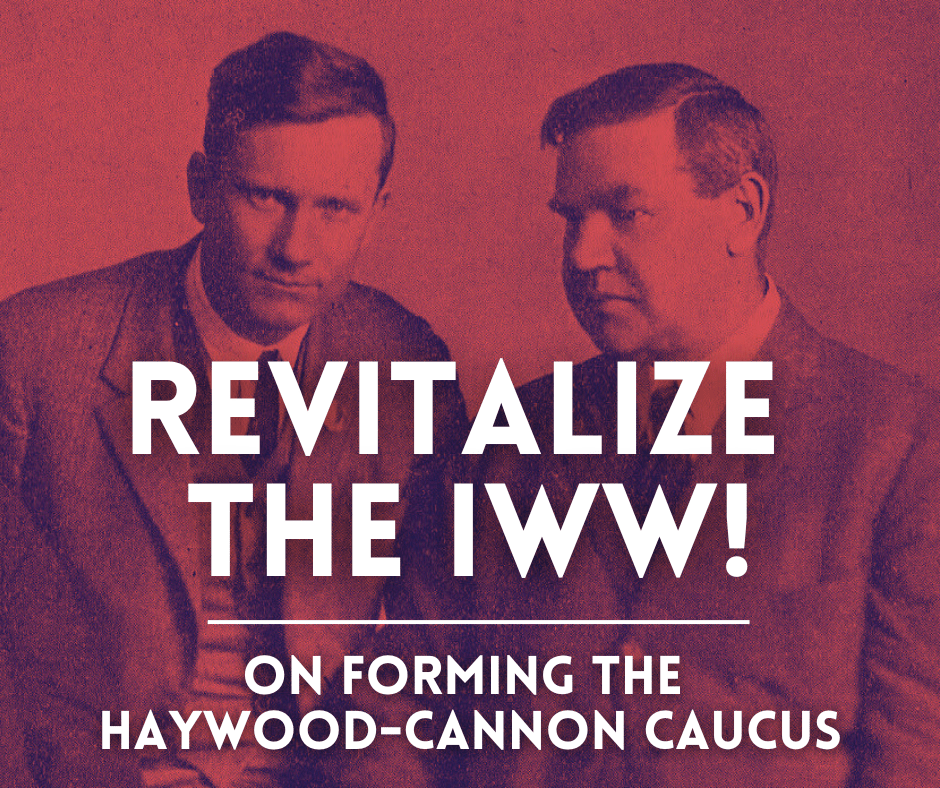
We all know the rich and heroic history of the Industrial Workers of the World. After the collapse of the first US industrial union – the Knights of Labor – which created the slogan “an injury to one is an injury to all” (and which the IWW later adopted) the IWW was formed by many of the worker militants who came out of the KoL, still seeing the need for one big union based on a class struggle orientation and against the elitist and reactionary American Federation of Labor.
The IWW is most well known for its first 20 years of existence defined by exceptional labor leaders organizing mass strikes across the country and fighting to build the economic and political power of the US working class. These IWW labor leaders included the most prominent revolutionaries in all of US history including the likes of Eugene Debs, Elizabeth Gurly Flynn, Big Bill Haywood, Lucy Parsons, James P. Cannon, and William Z Foster. After the first successful workers revolution in world history in 1917 many of these same wobblies went on to join and lead the US communist party supported by the Communist International and struggled to unite revolutionary unionists into the Communist International and its Red International of Labor Unions in order to more effectively coordinate the global revolutionary movement against the wage system and in support of the Soviet Union.
The IWW clearly terrified the US ruling class, which sought to criminalize the union and jail or lynch its leaders and membership. This drove many wobbly leaders to flee political persecution in the US, taking up residency in the Soviet Union as they worked to further workers’ revolution from the world headquarters of communism in Russia. It was during the interwar period in which the IWW began to rapidly decline due to massive state repression and the neutralization of much of the wobbly leadership, as well as sectarian infighting within the union between anticommunists and wobblies won over to the qualitative advance set forth by the Russian proletariat and their party.
Since then the IWW has never reached the same level of mass influence and leadership within the US working class. It has remained a marginal union with a membership as large (or small) as some union locals in the business unions. The marginality of the union is in part due to an inability of the IWW to adapt to our current conjuncture. The question is how do we make the IWW relevant again? Our answer coincides with the formation of the Haywood-Cannon Caucus based on the revolutionary legacy of prominent wobbly leaders Big Bill Haywood and James P. Cannon.
We propose a platform based on the theoretical traditions of these two giants of labor as a course correction for the IWW to become a major player in the US labor movement once again.
- We call for amending the IWW constitution to not only allow the endorsement of political parties, but to actively promote union support for an independent working class party and candidates rooted in the unions and against any support for bourgeois parties such as the Democrats, Republicans, or Greens.
- We call for the formation of a Dual Card Committee to systematically coordinate and further IWW principles within the business unions for those wobblies who are both in the IWW and a business union. As of now our dual card members are disorganized and lack direction in better realizing IWW principles within the business unions, thus allowing liberal hegemony to remain intact within the business unions. We should bore from within wherever wobblies are already present within the business unions.
- We need an army of organizers. There is great frustration among the rank and file on how the Organizing Department has created a bottleneck on conducting one of the most valuable resources the IWW offers its membership – the Organizer Trainings. Members have repeatedly applied to become certified to conduct OTs only to never receive a response let alone certification to build a larger force of OT organizers. We propose a standard that all IWW branches must have at least two certified OT trainers so as to facilitate more trainings and reduce the unnecessary costs of transporting certified trainers from one side of the country to the other which burdens local branches who are financially weak.
- The IWW must break out of its boutique unionism which targets small shops and look to unionize large corporate employers. While all workers should be unionized no matter the size of the shop, we will never build real worker power only unionizing small mom and pop shops.
- We should promote amalgamation and the one big union towards other unions to strengthen the working class into one mass movement marching towards the emancipation of labor as we build a workers united front.
- We should not fetishize the DIY attitude within the union relying on free labor of workers to run the union administration. The union has experienced a problem of workload just to maintain its legal status for the sake of having as few paid officers as possible. If the union needs paid professionals to administer the union then we should do so for the sake of smooth operations. This is not to relinquish control of the union to a labor bureaucracy, but to have faith in ourselves to properly hold paid employees of the union to account according to the principles of the IWW.
- A mass propaganda campaign must be waged by the union to popularize and familiarize the US working class towards the IWW and its mission. There should be regular paid advertisement across social media platforms to reach especially younger workers who don’t read print newspapers.
- The creation of a political education committee which will educate wobblies and the working class on the fundamentals of the capitalist mode of production and the strategy for realizing communism.
If you wish to join the Haywood-Cannon Caucus please click here
 The Virginia Worker
Leave a comment