

Truetimber Arborists in Richmond has become the first ever residential tree care company to be unionized in the US. An IAM Local 10 union member submits the following report on their successful efforts on the union campaign and what caused it.
On Thursday, May 30th in Richmond, VA, Truetimber Arborists became America’s first unionized residential tree care company by a blowout vote. After years of promises from our founder to sell the company to the employees, we were instead sold to a cleverly branded, tree care-focused private equity firm called Canopy Service Partners (a strategic cutout of much larger firm Alpine Investors). After the buyout, our profit share program was summarily canceled without announcement. Given that none of us were going to wait around to see what other benefits were on the chopping block, union authorization cards were soon to follow, with a near-entire bargaining unit having signed on for representation by the IAM Local 10. After weeks of coordinated union busting efforts by Truetimber’s new parent company, such efforts proved futile, and the election succeeded in a landslide victory.
Save for line clearance tree trimming, which is often unionized through the IBEW due to its close proximity to the heavily unionized electrical trade, the American tree care industry is highly unorganized— but why is that so, and what does this mean for the industry at large? The answer lies in an examination of the uniquely lax labor standards in American arboriculture, the woeful lag in formal recognition of tree work as a skilled trade, and the growing opportunism of private equity as such firms descend on more niche industries with weak organized labor and little regulatory oversight. As both a tree worker and union organizer at Truetimber, I witnessed the process from the beginning.
It was only a matter of time before an acquisition like this occurred, and only a matter of time before we responded in turn. Our company is a special one in the industry, and this is well-known; extremely high standards of skill and safety, a solid compensation package (relative to the industry), and a unique company culture centered around making highly adept tree climbers. We even have the paperwork completed for the first accredited in-house tree climbing trade school. The same superlatives cannot be given to the vast majority of American tree care companies, as there are minimal regulations on who can work on trees, what standards of safety they must employ, and what sorts of credentials one must have to start a tree care business.
While underappreciated as such, tree care is a critically important industry for the functioning of society. Without skilled and knowledgeable arborists, we would live in a world surrounded by imminent danger and uncertainty as poorly managed trees would routinely destroy critical infrastructure and property. Many forget that we are often considered essential workers alongside power linemen after rough storms. However, a vast majority of states, Virginia included, do not require any sort of special tree care license (or insurance) to operate a business where a high level of arboricultural knowledge and technical skill is required to safely and responsibly manage trees.
Industry institutions such as the ISA (International Society of Arboriculture) and the TCIA (Tree Care Industry Association) work to create better standards and systems for professional certification in the industry (i.e. the coveted ISA Certified Arborist certification), but these systems and standards often wind up being simply aesthetic given their scant relationship to any law or regulation requiring their presence within businesses. Only a minority of states (such as Maryland) have some kind of regulation of the trade through state licensure requirements, which naturally boost both the quality of work and working conditions across the board. Sometimes, regulations might only exist in certain portions of states, such as with Virginia, where parts of NoVA are beholden to the Chesapeake Bay Preservation Act, which imposes strict rules on tree work within certain sensitive zones. At large, however, America is the only Western nation that doesn’t require any kind of proof that you know what you are doing as an arborist. This is bad for everyone in the equation.
To start, this lack of oversight winds up causing a consumer protection failure. The average client does not (and shouldn’t be expected to) understand the intricate and species-specific knowledge required to prune a tree without harming or killing it, so opportunistic, low-knowledge, low-skill tree care companies end up cashing in big by offering poor, dangerous work for heinously low prices. This secures future work for them, too, as their poor pruning jobs on live trees one year often turn into much more expensive removal jobs on the same dead trees the following year. Unlike other industries— where the consequences of mistakes are much more immediate—in tree care,it’s a slow burn; you won’t know you’ve been screwed over until your tree informs you many seasons later. This is not only a routine scam— it is a public danger
On the worker-safety side, this is also a tragedy. Tree care companies must at least abide by basic OSHA safety standards, but the tree care industry has so many idiosyncrasies that set it apart from broad standards set by OSHA (i.e. proper chainsaw use while aloft in a tree), that an entirely separate set of safety standards, known as ANSI A300 and ANSI Z133, had to be developed just for tree care. ANSI (American National Standards Institute) is an organization that develops voluntary workplace standards, which means that no law requires any tree care company to abide by them. The corners are therefore ripe for the cutting to harvest profits, continuing to supplant tree work as one of the most dangerous jobs in the world, with 15 times the average job fatality rate. It doesn’t need to be this way. The stakes are incredibly high, but the accountability is incredibly low. So what does this spell for a company like Truetimber, with a staff loaded with highly skilled, safety-informed, and certified arborists? It spells precarity.
Truetimber strives to be the best in an industry where mediocrity and corner-cutting is rewarded, and where low-quality and dangerous work goes on with impunity. Such work is usually far cheaper, thereby forcing our bids to try and compete, thereby putting downward pressure on the wages of highly skilled arborists who deserve more. This results in an inverse relationship between skill-level and incentive to stay in the industry; the tougher and more dangerous trees that we are placed in, the more we start to wonder if we are “paid enough for this shit.” Thus, many tree workers don’t stay long in the industry, or we hop around due to little incentive to stay at one company, further obscuring the possibility of a collective bargaining effort. Truetimber currently sits at the apex of this series of contradictions, just in time for private equity to enter the picture, and with just enough employee retention for a successful union drive to temper it. And so it was.
For those unfamiliar, the private equity model consists of purchasing companies with a small amount of cash and a large amount of debt (in the acquired company’s name), restructuring the business so as to maximize profit, and then selling the company for a multiple of the original purchase price after a few years. It’s the same process we see in Virginia happening to low-income housing. In the context of the tree care industry, this is a potential goldmine. Firms can scoop up companies such as ours with voluntarily high standards of skill, compensation, and safety, and then slowly whittle away at those standards to boost profits with zero regulatory pushback.
They can continue to buy up more companies while promising no change in branding (a convenient selling point for founders) while slowly creating an illusion of choice between consumer options. Once they have enough hold on the market in an area, they can begin price fixing, thereby continuing to boost profits before recycling the companies to the next buyer, leaving behind a husk of what once was. To this end, we at Truetimber, the largest company in their portfolio, are their golden goose. If you are a skilled arborist at a similar company as ours, you could be on their list, too. One can foretell this story by looking at the HVAC industry where this has been going on for much longer, where similar firms such as Apex Service Partners, another Alpine Investors cutout (who even shares executive staff with Canopy), has reportedly engaged in this very practice.
We are among the first wave of tree care companies acquired by private equity, as our new parent company is the first of its kind, established only one year ago. A majority of states still do not recognize and protect the value of skilled tree care, so we are now an industry of sitting ducks. Therefore, the conditions are ripe for a new labor movement within American tree care and urban forestry. The need for industry reform is as dire as ever as niche private equity descends with no incentive to reform it themselves. Our new parent company has wasted no time in their pursuit, so we have responded by wasting no time in ours.
Before I end this piece, it would be important to go over our strategy for how we successfully unionized. Conveniently, I had developed a rapport with the IAM Local 10 a year prior, when a frustrating series of events transpired between my team and management. The IAM felt like a natural choice given their absorption of the International Woodworkers of America, an industrial forestry union, in the ‘90s. Nothing developed out of that first introduction with the union, but I had at least built a line of communication in case anything were to develop down the road.
This established rapport better prepared us to strike while the iron was hot after our acquisition. Conditions quickly became apt for a union campaign, as sentiment around the shop shifted increasingly toward suspicion in the wake of the profit share debacle and a handful of poorly delivered company meetings. Legacy employees grew ever more frustrated, as they came to grips with the fact that the years-long promise the founder had made to eventually sell the company to them had been unceremoniously broken. Had their loyalty been for naught?
Within weeks of the acquisition, I had privately contacted a handful of especially frustrated and skeptical coworkers and invited them to a meeting at the Local 10 hall with their business rep. I also wanted to ensure that this first group was representative of as many teams on field staff as possible in order to most efficiently gather sentiment and disseminate information about the campaign. It just so happened that a few others had unionizing on their mind, so things came together quickly. After this first meeting, we split up and started dispersing authorization cards, first contacting those we were confident would be “good bets”. It just so happened that a majority of staff were very good bets, and 80% of our prospective bargaining unit signed cards within two weeks.
After cards were gathered, we scheduled one more meeting at the hall with as much of the bargaining unit as possible to ensure everyone was on the same page about what was about to happen, as well as to prepare the group for the incoming counter-campaign by Canopy.
As anticipated, they tried every trick in the book. The first thing we discovered was that Canopy had lawyered up with hotshot anti-union law firm Foley & Lardner, and then proactively petitioned for the union on top of our initial petition in order to gain more control over the bargaining unit. This resulted in them adding a few more staff members from the office to try and dilute the voting pool (we initially opted out of including them since their job classification was so different from field staff, but the more the merrier!). Then, the newly installed Truetimber CEO, who we had superficially met maybe once before, suddenly existed again, gladhanding staff in the shop parking lot and even appearing on job sites to express his sudden deep personal care for the company.
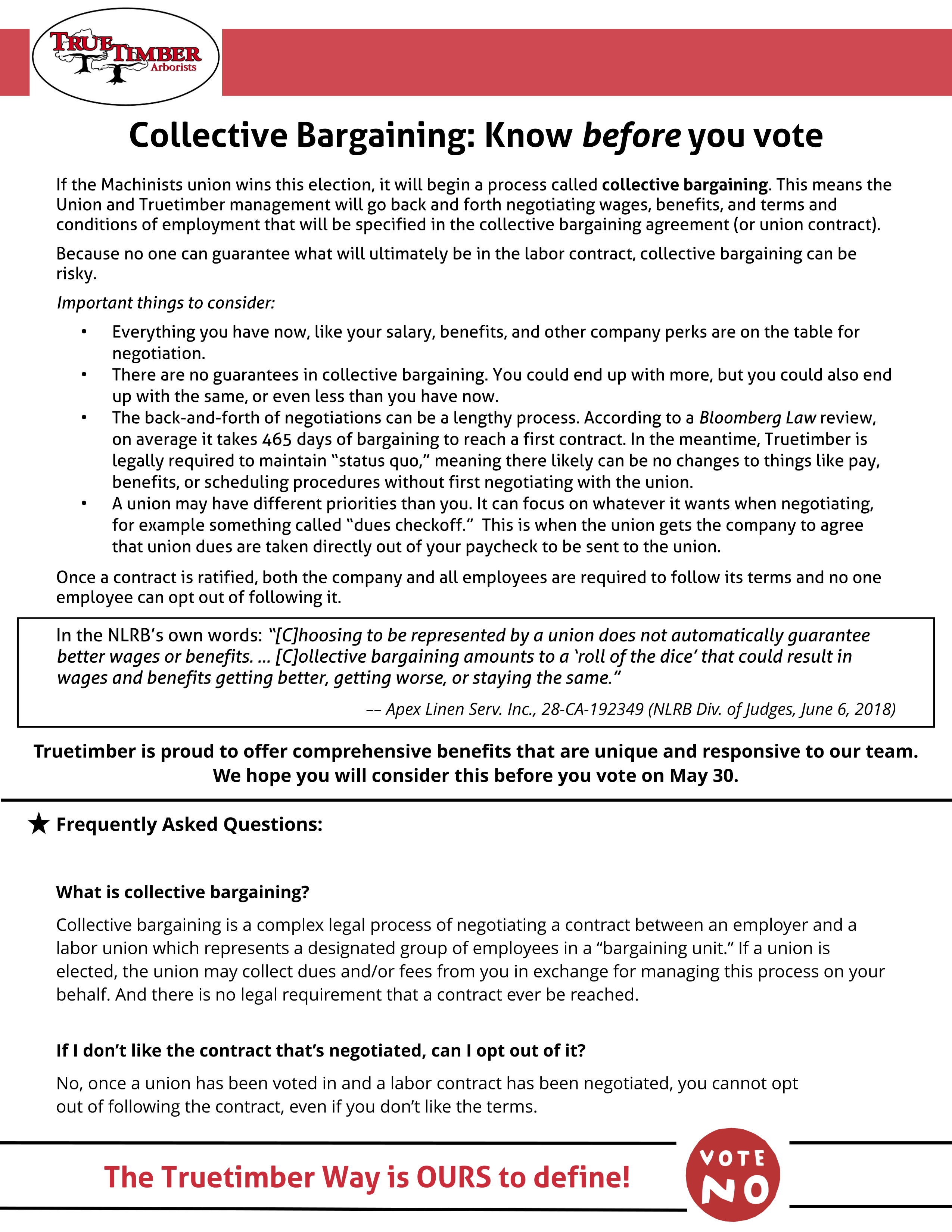
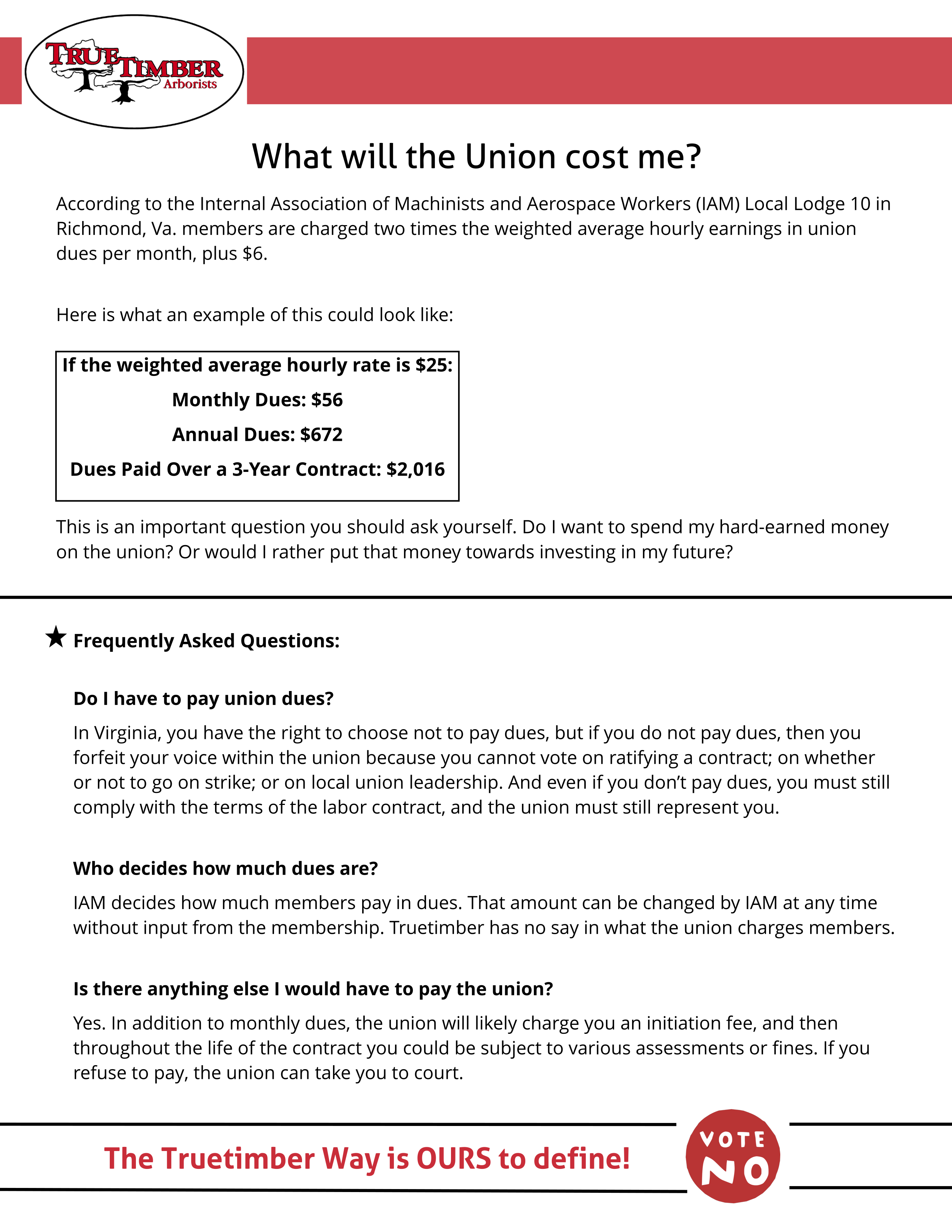
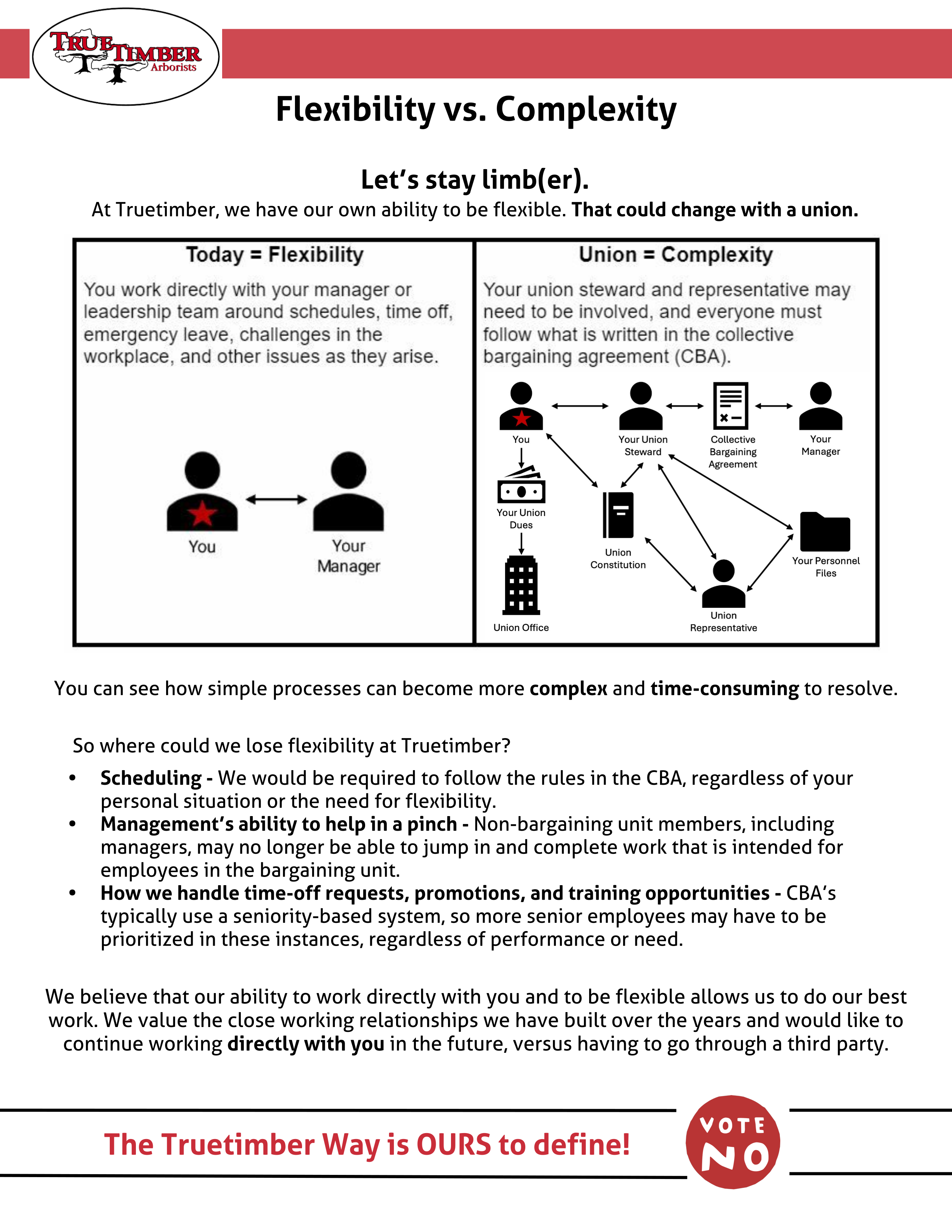
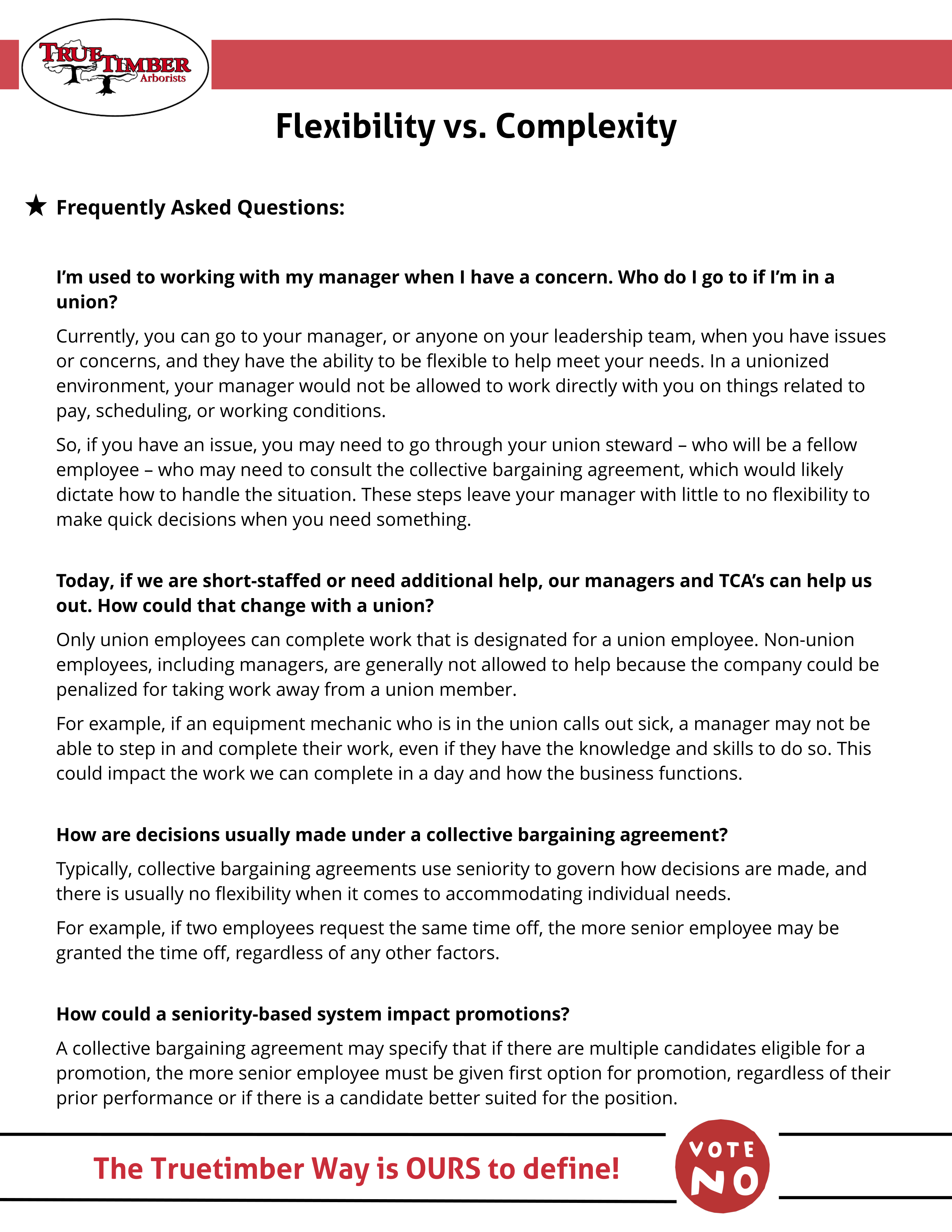
Soon enough, anti-union pamphlets started making the rounds, “educating” us on the stiff bureaucracy and ideological impositions a union would impose on our “way of life” at Truetimber, as if our “way of life” hadn’t already been sold off to a nihilistic financial intermediary a month prior. In between these displays we were treated to emotive speeches by management, expressing how Canopy loves us and only wants to see us grow, never once touching the profit share issue, and – almost as if coached – changing the subject whenever given pushback on any misinformation we were given. These tactics did them no favors, and it hurt to witness, as many of us are close friends with management staff. We didn’t blame them, however, as we had reasoned that Canopy had clearly been engaging in scare tactics to convince them the union was a boogeyman. This is not on our friends in management, it is on the strangers who manage them. Through it all, the official union election was a success, winning by an overwhelming supermajority. The level of camaraderie displayed during this effort has been astounding.
Witnessing a group of like-minded coworkers come together in such a spontaneously coordinated way was nothing short of inspiring. It is a true testament to how much we love our jobs, want to keep loving our jobs, and even improve them if we can. Now with the IAM in our corner, we can negotiate to incorporate such critical union-specific benefits as an income-replacement program for injured workers, discounted college tuition for those looking to further their arboriculture career, or the union pension program so we can reasonably hope to retire. These are all benefits Truetimber should want to boast about in its pursuit of becoming the best place to work in the industry.
Now that Truetimber has unionized, we have two avenues by which we can advocate for both ourselves and our industry. First, we have a collective voice with which to balance the scales in our immediate place of work. Second, we have a direct pathway of political advocacy through our union, the IAM, to voice our concerns more handily to Virginia lawmakers. This is an unprecedented development in our industry, and a rising tide which will inevitably lift all ships. It is time for our trade to get the respect it deserves before it becomes financialized beyond reproach. Now or never.

 The Virginia Worker
Leave a comment